
Improved monsoon, solid fiscal performance, and capex push by the public and private sectors augurs well for India's macroeconomic stability and growth, the finance ministry's monthly economic review for June 2023 said. But the report said that while India's domestic fundamentals remain strong, negative cross-border spillovers and adverse global developments could act as a deterrent in achieving the high growth path this financial year. "An improved matching of aggregate supply and aggregate demand in the Indian economy underpins the progress made in the control of domestic inflation and the consequent strengthening of macroeconomic stability," the review said.

Government's focus on infrastructure is the biggest positive for the Indian economy, followed by the improvement in tax collections and good consumption recovery.

Prime Minister Narendra Modi made a pitch for electing a strong and stable government in an uncertain world beset by geopolitical tensions as the Bharatiya Janata Party on Sunday released its manifesto, prioritising development and welfare while shunning populist measures and contentious issues like the National Register of Citizens (NRC).

The unexpected missile attack on a second India-bound ship carrying Russian crude, just three weeks after the first, has complicated matters for domestic refiners. India now counts the Vladimir Putin-led nation as its biggest oil supplier, according to Paris-based market intelligence agency Kpler, and these attacks come on top of US sanctions since December, where vessels that bring crude to India are facing heightened scrutiny. Panama-registered Pollux, which loaded crude at the Sheshkaris oil terminal in the Russian port of Novorossiysk on January 24, was scheduled to deliver the medium, sour Urals grade to Paradip port on February 28.

In the Sensex pack, Yes Bank, IndusInd Bank, Infosys, ICICI Bank, TCS, SBI, Reliance Industries, ONGC, Axis Bank and NTPC rose up to 2.66 per cent.

Why millennials are choosing silver over gold this Valentine's Day.

Rising for the fourth straight day, benchmark indices Sensex and Nifty settled marginally higher after a choppy session on Friday, tracking mixed global trends amid uncertainties on the geopolitical front. The BSE Sensex opened weak and declined 414.44 points to 55,049.95 in opening deals. But within minutes, it pared all its losses and jumped 369.56 points to 55,833.95. Facing volatility, the index finally settled at 55,550.30, higher by 85.91 points or 0.15 per cent.

Lack of access to the cosmonaut training programmes would also be a hindrance for ISRO's planned manned missions, explains Devangshu Datta.

Vegetable rates may ease from September, led by tomato prices, which have started showing signs of correction on the back of increased supply, Reserve Bank of India (RBI) Governor Shaktikanta Das said on Wednesday. "Looking ahead, the spike in vegetable prices in July is starting to see a correction, led by tomato prices. "New arrivals of tomatoes in mandis are already softening the prices, coupled with proactive supply management in the case of onions.

The finance ministry has cautioned that global and regional uncertainties and domestic disruptions may keep inflationary pressures elevated in the coming months, warranting "greater vigilance" by the government and the Reserve Bank of India (RBI). "Russia's decision to terminate the Black Sea grain deal, along with dry conditions in major wheat-growing areas, caused a price spike in cereals. Domestic factors like white fly disease and an uneven distribution of monsoon exerted pressure on vegetable prices in India," the ministry said in its latest Monthly Economic Report for July, released on Tuesday. However, the report maintained, the recent price surge in certain food items "is expected to be transitory". "Tomato prices are likely to decline with the arrival of fresh stocks by the end of August or early September.

Gold, the safest haven amid the ongoing uncertainty, also emerged as one of the most lucrative investment options in financial year 2022-23 with an impressive return of 16.1 per cent in rupee terms, and 2.3 per cent returns in dollars. And, had it not been for the very high inflow of smuggled gold and the huge discount prevailing in the market due to high prices, the returns in gold would have been much higher, analysts said. The precious metal has consistently been delivering positive returns in India since 2016.

Foreign investors pumped in Rs 11,119 crore in the Indian equities in December, making it the second consecutive monthly inflow, despite increasing concerns over the re-emergence of Covid-19 cases in some parts of the world. However, foreign portfolio investors (FPIs) have turned cautious in recent days. The inflow in December was much lower compared to Rs 36,239 crore invested by FPIs in the month of November, data with the depositories showed.

As many as 267 of 453 companies from the BSE500 index are trading above their consensus price targets, according to the data compiled by Bloomberg. Not all companies in the BSE500 index are tracked by analysts.

India's rupee is likely to remain under pressure due to high prices of crude oil and other commodities, and may stabilise at around 79-80 against the US dollar in the near term, say experts amid limited headroom available with the Reserve Bank to check the weakening of the domestic currency. The currency has slumped over 5 per cent this year after Russia's invasion of Ukraine sent international crude oil prices soaring to a decade high. On Monday, rupee ended at a fresh all-time low of 78.34 (provisional) against the US dollar.

'Geopolitical risks and their impact on oil prices, if any, are another concern for global markets, particularly for India.'

'We will see a lot of investments from the private sector.' 'As long as we are not impacted by some global events, I think we will be in a strong place.'

In a dazzling resurgence, foreign investors have graced the Indian equity markets with an influx of nearly Rs 1.5 lakh crore in 2023, fuelled by optimism over the country's resilient economic fundamentals amid shadows of a gloomy global scenario. Experts believe that the positive trend may continue in 2024. This follows Indian equities witnessing the worst-ever net outflow of Rs 1.21 lakh crore by FPIs in 2022 on aggressive rate hikes by the central banks globally after net inflows for three consecutive years.

Strong macroeconomic headwinds causing turbulence in the $245-billion Indian IT industry are yet to calm down. Top Indian IT services companies are likely to post a decline or just marginal growth in sequential revenue in Q1FY24 because of a soft discretionary spending environment. Though the first quarter is seasonally strong for IT firms, "June 2023 will be an exception", according to analysts at Kotak Institutional Equities.
Indian growth in the rest of this fiscal year and next will be propelled by robust domestic consumption as consumer confidence improves, and by investment, including large increases in government capital expenditure, according to the Asian Development Outlook September 2023. "As slowing exports could foment headwinds for the economy, and erratic rainfall patterns are likely to undermine agricultural output, the growth forecast for FY2023 is revised down marginally to 6.3 per cent," ADB said.

India appears poised to sustain its growth in a more durable way than before with the economy carrying the momentum from FY23 into the current fiscal year, the Annual Economic Review for 2022-23 released by the finance ministry on Thursday said. However, the report cautioned that escalation of geopolitical stress, enhanced volatility in global financial systems, sharp price correction in global stock markets, a high magnitude of El-Nino impact, and modest trade activity and FDI inflows, are factors that could constrain the pace of growth. "Should these developments deepen and dampen growth in the subsequent quarters, the external sector may challenge India's growth outlook for FY24," the finance ministry said.

Market participants attribute the stability to the Reserve Bank of India's timely intervention in the foreign exchange market, both in terms of selling and buying dollars.

Foreign portfolio investors (FPIs) pulled out as much as Rs 17,537 crore from the Indian markets in just three trading sessions of March as investors' sentiment got dented by the uncertainty triggered by the Russia-Ukraine conflict and rising crude oil prices. As per depositories data, they pulled out Rs 14,721 crore from equities, Rs 2,808 crore from debt segment and Rs 9 crore from hybrid instruments between March 2-4. This took the total net outflow to Rs 17,537 crore.

Any market correction, analysts say, would be an attractive entry point for risky assets, which should do well over the medium-to-long term.

These stocks offer the best combination of maximum 'buy' recommendations from brokerages and share price upside over the next 12 months.

The Reserve Bank of India on Thursday decided to keep policy rate unchanged for third time in a row as it maintains heightened vigil on inflation. The rate increase cycle was paused in April after six consecutive rate hikes aggregating to 250 basis points since May 2022.

According to the global financial services major, inflation may remain sticky, with a possible El Nino effect on the monsoon likely to push up food prices and geopolitical uncertainties seen pumping up global commodity rates.

US interest rate normalisation policy is likely to keep global FX markets volatile.
India's economic growth will be above 6 per cent in the current fiscal as the country has managed to strengthen its macroeconomic stability and performance even in a period of large global shocks, RBI Monetary Policy Committee (MPC) Member Ashima Goyal said on Monday. Goyal further said that a global slowdown reducing India's export growth, geopolitics fueling oil and food prices, and erratic weather are some of the continuing risks that the country faces. "India has managed to strengthen its macroeconomic stability and performance even in a period of large global shocks.
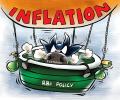
The RBI on Friday retained inflation forecast for FY23 at 6.7 per cent amid uncertain price trajectory on "geopolitical shocks" and on hope that inflationary pressures would ease with pick-up in kharif sowing and supply chain improvements. In its previous monetary policy review in June, it had projected retail inflation for 2022-23 at 6.7 per cent, higher from 5.7 per cent forecast in April. The six-member Monetary Policy Committee (MPC) unanimously decided to raise the benchmark repo rate by a steep 50 basis points to 5.40 per cent with immediate effect to tame inflation while supporting growth.

Reserve Bank Governor Shaktikanta Das on Thursday described cryptocurrencies as "clear danger" and said that anything that derives value based on make believe, without any underlying, is just speculation under a sophisticated name. The government is in the process of finalising a consultation paper on cryptocurrencies after gathering inputs from various stakeholders and institutions. Reserve Bank of India (RBI) has been flagging concerns about cryptocurrencies, which are seen as a highly speculative asset.

With the international markets facing uncertainty after Russia invaded Ukraine and Western nations retaliated with sanctions, Indian companies are putting their international fundraising plans on hold as they wait for the markets to recover. Bankers said apart from the geopolitical crisis, international rates are hardening in anticipation of interest rate hikes by the US Federal Reserve to control rising prices in the US. The Ukraine situation has implications for the market. In such a situation, international investors try to shift to safe haven assets by exiting from emerging markets.

As per the findings, CEOs are less optimistic about prospects this year.

India's dream to be in the forefront of international politics has come true. India has placed itself firmly as a major player in the shaping of a new world order, observes Ambassador T P Sreenivasan.

The stocks could tank more than what it did after the United Progressive Alliance-1 came to power in 2004, as the market has not yet priced in a Bharatiya Janata Party defeat, says Raj Bhatt.

India's voting pattern in the United Nations with regard to the Israel-Palestine conflict is lately marked by a calibrated distancing from Israel, observes Ambassador M K Bhadrakumar.

Billionaire Mukesh Ambani's Reliance Industries Ltd on Friday reported a 22.5 per cent rise in net profit for the quarter ended March on the back of bumper oil refining margins, steady growth in telecom and digital services and strong momentum in the retail business. The oil-to-retail-to-telecom conglomerate's consolidated net profit rose to Rs 16,203 crore in the quarter ended March 31, 2022 from Rs 13,227 crore, the firm said in a statement. Net profit, however, fell 12.6 per cent sequentially -- breaking a six-quarter chain of quarter-on-quarter improvement.

Private equity investments into domestic companies fell sharply year-on-year by 42 per cent to $23.3 billion in 2022, which is the lowest since 2019, when it was $15.8 billion, according to an industry report. The numbers reflect the overall funding winter that the startup space in particular, and the overall foreign investments in general have been witnessing since the Ukraine war began last February. Private equity investment inflows into the country fell by a sharp 42 per cent in 2022 from last year to $23.3 billion -- the lowest annual inflows since 2019 when it was a low $15.8 billion, but still relatively elevated compared to historical levels, said Elaine Tan, a senior analyst at Refinitiv, the LSEG business arm that provides financial markets data and insights.

Every 10 per cent rise in crude oil price will shave off around 0.2 percentage point (pp) from India's GDP growth and widen the current account by 0.3 per cent, says Nomura.

Experts advise investors to buy at lower levels in the next few months and sell at the higher end of their range in the second half, reports Rajesh Bhayani.

'Calendar year 2023 is going to be big as pessimism takes a back seat.'
